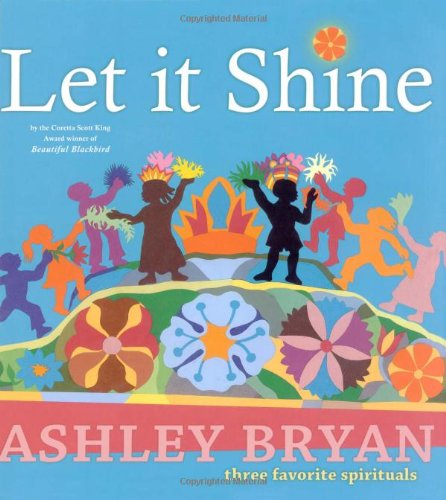
“Let it Shine,” “Oh When the Saints Go
Marching In,” and “He’s Got the Whole World In His Hands” are three popular
spirituals that originated in the African-American community. Ashley Bryan
brings these spirituals to life with a burst of bold colors and patchwork style
images. This book will have kids out their seat singing and dancing.

Collier, B. (2000). Uptown.
New York: Henry Holt.
Take a tour of Harlem with a young boy as he
shows us some of his favorite spots in Uptown. Eat chicken and waffle, see the
brownstones, go shopping on 125th Street, see a great show at The Apollo
Theatre, listen to smooth jazz, or meet on the court for a game of basketball.
Fun colors that pop and staggered words in realistic pictures, convey all the
things that make Harlem home.
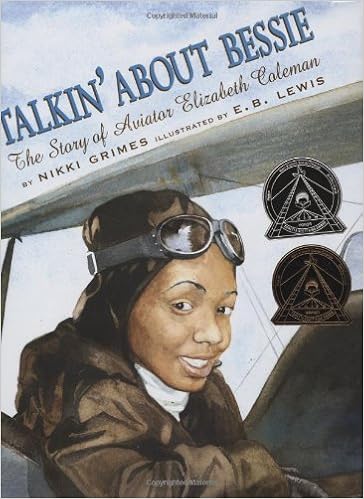
Grimes, N., &
Lewis, E. B. (2002).Talkin' about Bessie: The story of aviator Elizabeth
Coleman. New York: Orchard Books.
Similar to many people, Elizabeth had a tough
time trying to figure out what to do with her life, especially being a young
African-American girl growing up in the Jim Crow era, but Bessie didn’t let
that kill her determination. Once she figured out her calling, she pursued her
passion wholeheartedly to be the first African-American woman to fly. Told in
series of monologues from classmates, reporters, and family, children will
enjoy the strong message to always follow their dreams.

McKissack, P., & Pinkney, J. (2001). Goin'
someplace special. New York: Athenaeum Books for Young Readers.
Tricia is finally taking a trip to Someplace
Special by herself for the very first time. As Tricia sets out on her adventure
she encounters a few Jim Crow obstacles along the way. Will Tricia give up and
turn around? Read along as Tricia fights through diversity to remember what
makes Someplace Special such a magical place.
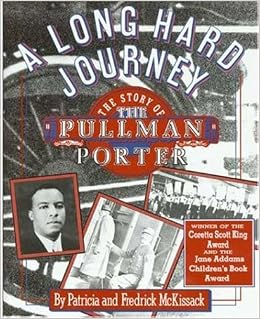
McKissack, P., & McKissack, F. (1989). A
long hard journey: The story of the Pullman porter. New York: Walker.
When
slaves were free lots of them became porters, a person employed to carry
luggage for the railroad, but little did they know as one struggle was ending another
was just beginning. Read about how porters came together as a union called The
Brotherhood of Sleeping Car Porters to fight against unfair labor laws,
horrible working conditions, and poor pay wages. This information packed book
is separated into three sections and displays a wealth of original pictures to
aid the timeline.

Morrison, T. (2004). Remember: The journey
to school integration. Boston: Houghton Mifflin.
The
road to integrated schools was long and hard, but Toni Morrison’s collection of
pictures walks us through the timeline of events with fictional annotations
that are sure to pull at your heartstrings. This book serves as a history
lesson and a trip down memory lane for some to remember just how far we’ve come
and visually capture hate, love, fear, and courage to tell a story that must
always be remembered.
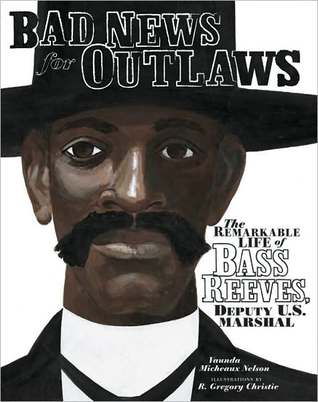
Nelson, V. M., & Christie, R. G. (2009). Bad news for outlaws: The remarkable life of Bass Reeves, deputy U.S. marshal. Minneapolis: Carolrhoda Books.
Bass Reeves is the most feared U.S. marshal in the Indian Territory. With over three thousand arrests and only fourteen casualties during his line of duty, Reeves was also one of the most respected marshals in his community.Born into slavery in 1838, Reeves had a tough life, but didn’t let anything stop him. Introduce kids to an unfamiliar part of history as we
relive Reeves’s adventures through beautifully painted pictures by
multi-award winning illustrator R. Gregory Christie.

Siegelson, K. L., & Pinkney, J. B. (1999).
In the time of the drums. New York: Jump at the Sun/Hyperion Books for
children.
As a young island boy, Mentu always asks Twi,
his grandmother, when it will be his turn to be a strong-strong man, but
Mentu’s time comes faster than he expects when Twi leaves for good to lead a
boatful of slaves back to Africa. Award winning artist Brian Pinkney makes this
African legend to come to life with his captivating images that retell a myth
of keeping tradition alive and staying true to yourself.


Steptoe, J. (1987). Mufaro's Beautiful
Daughters: An African Tale. New York, NY: Scholastic.
Mufaro has two
daughters, Nyasha and Manyara, who everyone agrees are the most beautiful in the land. As a result, the
king summons both girls to meet him so that he will choose his wife. Manyara is confident that she will be chosen, but
what she doesn’t notice is the
series of tests that she faces before she even steps foot in front of the king.This is a beautiful legend told
with rich images.

Taylor, M. D., & Ginsburg, M. (1987). The
friendship. New York: Dial Books for Young Readers.
The year is 1933 and life is full of rules.
For example, Cassie’s mom doesn’t allow her and her siblings to go to Wallace
Place and white people must be addressed as Mr. or Mrs., but both rules are
broken as the kids go to Wallace Place to retrieve medicine for their neighbor
and Mr. Tom Bee addresses the store owner, John Wallace, by his first name.
After several warning, Mr. Tom Bee continues to call John by his first name and
the children are forced to witness an unforgettable event.
