Friday, April 29, 2016

Textbook Assignment 6


Bell, C. (2014). El Deafo. New York: Abrams. 

Imagine if one day you lost your hearing. Would your friends, teachers, or family treat you differently? Would you still be able to participate in your normal activities? Would you want to wear an hearing aid? Have you ever been through something and felt like you really couldn't communicate to others what you are feeling? These are just a few of the dilemmas Cece experiences as she loses her hearing and begins wearing hearing aid devices to assist her in life. Fortunately her hearing disability does come with some privileges, she transforms in to the superhero El Deafo to get through tough situations and learns to live with her disability and some other adolescent problems along the way.

*I would ask my students have their ever felt different, like they didn't belong, or were misunderstood, but could not relate their feelings. I think students with disabilities would naturally be drawn to this book, but I would also push this book to students who I know love graphic novels because of the vivid colors and images in the book.


Creech, S. (2001). Love that dog. NY: HarperCollins.

Similar to you, Jack was less than enthusiastic when his teacher started having him write poetry. He starts out slow writing things that he really doesn't believe is poetry, but over time as he's introduced to great poets like Walter Dean Myers, Robert Frost, and Valerie Worth, he begins to understand poetry, use it as a outlet, and even writes Mr. Myers, requesting him to come to his school. Read this book and watch Jack's love for poetry unfold. You never know. You might end up liking poetry too!


*I would sell this book based on its simplicity. I would conduct a book talk and try to interest pet lovers, or any kid who has experienced death in any form. I would emphasize poetry as an outlet and show how Jack discovers poetry in a way that is natural for him. Using this book as an example that, not all poems are difficult to understand, and possibly show a sample to prove how easy of a read it is.


 Selznick, B. (2007). Wonderstruck. NY: Scholastic. 

Don't be intimidated by this book's size! There are two stories in this book. Ben's story, which is told through words, and Rose's story, which is told through pictures. Both  children set out on an adventure to find something that they are missing in life, but at the end their stories intertwine to unlock a treasure of answers they've been looking for this entire time. Will Ben be reunited with his father after his mother's fatal car accident? While Rose find her place in the world as a young deaf girl? Start reading now to find out.

*I would sell this book to my kids by asking has anyone seen the move The Invention of Hugo Cabaret. In further detail, I would explain to them that this is the same author who wrote the book and continue talking about the author's unique style. 


Woodson, J. (2014). Brown girl dreaming. New York: Penguin.

This is a book of poems by  Jacqueline Woodson who tells the story of her life as a young African-American girl during the Civil Rights Era. Throughout Jacqueline's life, you might relate to many things she sees happening amongst her family: the separation of her mother and father, feeling torn between homes, a strict upbringing, friendship, being the new/different kid, sickness, death, and incarceration in her family. Her story shines a different light on events that happened during the Civil Rights Movement and the major difference between the North and South during those times. Read Jacqueline's story as she finds a name for herself despite her overcastting  shadow of  her "brilliant" older sibling and the trails of her family. What are your dreams? What is it like for a brown girl dreaming? Read this book now,  and you might have more in common than you think.

*I would sell this book by talking about the issues that Jacqueline goes through to appeal to students who are not African-America but may be able to relate to some of her challenges. In particular students who may be from another country, city, or state and often feel torn between homes. I would also identify the historical significance for my students that are history buffs.  


Compare/Contrast Between Books


Brown Girl Dreaming/Love That Dog

These are two books composed of  poems, but yet one narrator is male and the other female. Though they both involve a quest figuring out their love of poetry, they are very different in their approach. Love That Dog tends to be more simplistic and light-hearted, while Brown Girl Dreaming overall touches on more serious topics in a reflective way from the narrator who also is the actual author making this book a biography in a sense. I see Love That Dog as an introduction to get kids to love poems while Brown Girl Dreaming may be a more intermediate level for students who are beginning to explore or already love poetry.


Comparison of Wonderstruck/El Deafo

The main characters in both stories are deaf, and trying to figure out certain things in their lives. While both Cece and Ben are not born death, we see the struggle of them adjusting to their new disability. We view them learning how to lip read and sign. In contrast, the pictures in El Deafo are full of color, and the drawings in Wonderstruck are shades of black, white, and gray, as if they were drawn with a pencil, but the pictures are still incredibly detailed and just as vivid. 


Other Books By The Authors

Jacqueline Woodson
1. Locomotion
2. Come Softly
3. Pecan Pie Baby

This author writes about a variety of different things, and while Brown Girl Dreaming was more of a childhood biography, I do see a common similarity between many of the books I researched by her. Most of her books describe real life issues that teens face from interracial dating, a new baby being born into the family, death, etc. Her books do tend to be mostly African-Americans. She writes for a wide age group. Her collection of work includes picture books like Pecan Pie Baby for children, and young adult novels such as Come Softly.
Sharon Creech
1. Hate That Cat
2. A Fine, Fine School
3. Replay

Sharon Creech writes books in a lighthearted manner for kids. Hate That Cat is a sequel to Love That Dog, so the style is fairly similar as it is written in verse. Whereas, Replay is written in the form of a play. Creech also has written three pictures books. One is titled A Fine, Fine School which also has a lighthearted tone.
Brain Selznick
1. The Invention of Hugo Cabret
2. The Marvels
3. The Houdini Box

Selznick has a distinct style in his books. He uses pencil drawings in all three of these books to assist with the story. Most of his main characters are male, and it seems as though there is always some adventure or puzzle pieced mystery.
Cece Bell
1. Bee-Wigged
2. Itty Bitty
3. Food Friends


All of Bell's book included illustrations which she drew herself. There is also a commonality of how she draws the pictures. El Deafo, Bee-Wigged, and Itty Bitty all seem to be drawn using acrylics. Food Friends includes pictures, but they are more simplistic in comparison to the other books.

Textbook Assignment 2 (Informational Text)

Bartoletti, S. C. (2005). Hitler Youth: Growing up in Hitler's shadow. New York: Scholastic Nonfiction.


Summary: A different side of the Nazis are shown as this book highlights the youth that were to help carry out Hitler's vision. It explains from the perspective of the youth and reveals the  promises that they were made. The primary picture sources are extremely helpful and paired with text that is understandable for youth. 


Evaluation Criteria: Bartoletti recounts a well known story and piece of history from an unfamiliar point of view. The reader is exposed to a personal perspective from Hitler's Youth.  Citing one hundred and fifteen sources in her bibliography, along with quote sources and authentic photographs from the online photograph collections at the Library of Congress, it is very evident that the author conducted detailed research to assemble this piece of literature. The Newbery and  Robert F. Sibert Honor Book Awards that the book has claimed prove as testaments .


Bishop, N. (2007). Spiders. New York: Scholastic Nonfiction.

Summary: This is an up close and personal book full of facts about spiders. The pictures are full page and aside from facts, the other gives readers other helpful tips that they might need to know about each particular spider.


Evaluation Criteria: The design of the book is aesthetically pleasing. The life size, vivid photos Bishop captures effectively illustrates the content being described in the text. The color of the pages and letters complement the pictures as well. For example, on the title page Bishop displays a colorful picture of a yellow crab spider. The page next to it is a deep burnt orange color with bold yellow letters to match the neighboring page. 


Bragg, G., & O'Malley, K. (2011). How they croaked: The awful ends of the awfully famous. New York: Walker Childrens.

Summary: Death doesn't always have to be a gloomy topic. The details of nineteen famous people are described in this book along with a short story about each "awfully famous" person and funny black and white illustrations. 


Evaluation Criteria: The immense amount of information in How They Croaked is organized in a practical way with some interesting additions. A table of contents,  by name, leads the book in addition to sources and an index at the conclusion. However, what I found most entertaining was the short bits of random fun facts that followed each "awfully famous" person's story. There is also a section in the shape of a tombstone at the beginning of every story that shares information about the birthplace, birthday, date of death, etc.


Giovanni, N., & Collier, B. (2005). Rosa. New York: Henry Holt.


Giovanni has a distinctive style considering the way the information is presented to the reader. The delivery of the story is not overly descriptive and sparks a level of  curiosity  that would make the reader continue to do research on their own about Brown versus Board of Education, Martin Luther King, Jr., Emmett Till, segregation, and much more. Collier's style strongly resembles collage or patch artwork that brings a fresh look to the book, and maybe further symbolizes all the cohesive pieces/patches that worked together to end segregation.


Harris, R. H., & Emberley, M. (1996). It's perfectly normal: A book about changing bodies, growing up, sex, and sexual health. Cambridge, MA: Candlewick Press.


It's Perfectly Normal has received an enormous amount of praise from experts and won several honorable awards. Harris gives straightforward, accurate, and understandable information to its readers about puberty, sex, families and babies, staying healthy, and decisions while Emberley creates realistic visuals that represent a variety of people and situations.


McDonnell, P. (2011). Me-- Jane. New York: Little, Brown.


McDonnell writes the book in very simple language that is easy for young readers to comprehend. The pictures  also slightly resemble a coloring book. This is an overall clear piece of work that gives a glimpse of Jane's life. 

Nelson, K. (2008). We are the ship: The story of Negro League baseball. New York: Jump at the Sun/Hyperion Books for Children.


Nelson cleverly organizes the book in parallel to the game of baseball itself with nine innings. These innings could be considered chapters. At the beginning of each inning/chapter there is a subtitle that describes the content of the section, but also a quote from a baseball figure that reinforces the topic. The organizational structure of this book isn't the only component that makes it a wonderful read, but surely a thoughtful bonus that readers will appreciate along with the additional Extra Innings chapter. 


Ottaviani, J., & Wicks, M. (n.d.). Primates: The fearless science of Jane Goodall, Dian Fossey, and Biruté Galdikas.


Primates is a book that young readers will enjoy. Due to its graphic novel set up, readers will feel like they are reading a comic book, but still learn valuable information about the three women who were leaders in their fields. The graphics are vibrant, clear, and organized in a format that is easy to follow.


Sweet, M., Newborn, R., & Paquette, C. (2011). Balloons over Broadway: The true story of the puppeteer of Macy's Parade. Boston, MA: Houghton Mifflin Books for Children. 


This book definitely exudes an artful appearance full of watercolor illustrations along with actual pages from Tony Sarg's Marionette Book. Both graphics work together seamlessly along with the text to inform readers. The original advertisement from the New York Times listed in the back of the book also ties in primary sources, reinforcing its informational genre.

Textbook Assignment 1

Brown, P. (2014). My teacher is a monster!: No, I am not. Little Brown Books For Young Reader.

Summary: Every child has that one teacher that they dislike, and Robert is terrified of Ms. Kirby until he runs into her outside of school at the park. Slowly Robert starts to see Ms. Kirby in a different light and his opinion of her changes, for now.

Visual Element: Brown exemplifies color through his illustrations in the book. In particular, the color of Ms. Kirby changes throughout the book as Robert’s opinion of her changes. The author starts off using a deep green color, and then slowly transfers into a peach color.This doesn’t happen quickly, but instead it is a slow, gradual change over a course of pages.

Evaluation Criteria: The two settings in this book are crucial. The original setting serves as the place where Robert’s initial opinion about Ms. Kirby is formed, but when he sees her in a different setting, his view of her starts to change and so does her physical appearance in the book. Because of the settings, the plot is able to progress and brings the book back in a full circle where it originally started. 


DePaola, T. (1990). The Legend of the bluebonnet. Place of publication not identified: Scholastic. 

Summary: This is a legend retold about a girl named She-Who-Is-Alone who has lost her family due to a famine. As her tribe looks for things to sacrifice to please The Great Spirits, many are not willing, but She-Who-Is-Alone sacrifices her most prized possession, her rag doll, and the next day a field of bluebonnets appear and the drought has ended.

Visual Element: The colors in this book reflected the different moods. During the famine the sky was plain white, or a very light brown. At times when they sang to the Great Spirits the sky would be a mixture of purple, blue, and pink, which made me think of hope. A light blue also crosses the sky when the rain begins to fall while blue bonnets color the hills that were once a light gray.

Evaluation Criteria: Through the characters’ names, clothes, speech, and rituals we see Native American culture. I believe the culture is presented in a way that would be interesting to children and inoffensive. There is also a good theme of sacrifice or selflessness taught that all students can relate to.


Deedy, C. A., & Austin, M. (2007). Martina, the beautiful cockroach: A Cuban folktale. Atlanta, GA: Peachtree.

Summary: Martina is a beautiful cockroach ready to find a husband, but first they must pass the test. Her grandmother tells her that she must waste coffee on the suitors and see how they respond, but Martina meets her match when she meets a mouse that spills coffee on her first.

Visual Element: Austin exemplifies texture through the images in this book with his particular attention to detail.The intricate detail used for the expression on Martina’s face as she goes through different emotions of trying to find a husband is so realistic that it is easy to forget that she is a cockroach.

Evaluation Criteria: The plot is exemplified in this Cuban folktale, beginning with a conflict. The plot flows as Martina meets different characters to see if they can pass this test to be her potential husband. The resolution is clear and satisfying as the characters both discover they share a huge similarity, Cuban grandmothers.


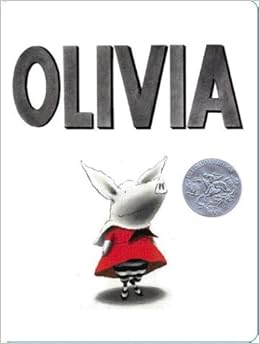
Falconer, I. (1975). Olivia. New York: Arno Press.

Summary: Get ready to follow Olivia around for a day through her various adventures and outfits. Busy body children will enjoy reading this book with their parents after a long, tiresome day.       

Visual Element: The entire book is mostly shades of grey , white, and black. The main color that Falconer uses to convey Olivia’s personality is red. Olivia wears red while doing some of her favorite activities such as brushing her teeth, trying on different clothes, going to the beach, dancing, and painting. This also distinguishes her from her little brother. Red reflects her energetic spirit.

Evaluation Criteria: Olivia’s character is certainly the major focal point of the book. She is full of life, always on the go, and good at wearing people out. Olivia’s lively character moves the story along and makes you think of children you know that may be very similar to her in our everyday lives.


Klassen, J. (2012). This is not my hat. Somerville, MA: Candlewick Press.

Summary: A little fish takes a hat that doesn't belong to him and he's sure he will get to a place full of high plants where he can't be seen. However, the big fish finds him and gets his hat back.

Visual Element: In This Is Not My Hat, the author-illustrator uses very few shapes to aid in the storytelling. The big fish's oval body is so large that it takes up two pages versus the smaller fish, whose oval body hardly takes up a tenth of the page. Even the leaves of the plants reflect an oval shape, sometimes taking over the page as much as the giant fish.

Evaluation Criteria: Even though the story is told from the point of view of the small fish, Klassen clearly exemplifies that the other characters play a vital role in the story and eventually dominate the story without ever speaking a word. The main character, small fish, is oblivious to the actions of the other two characters, the crab and big fish, and this ultimately leads to his demise.


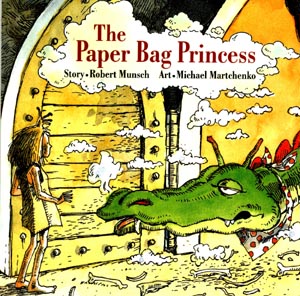
Munsch, R. N., & Martchenko, M. (1980). The paper bag princess. Toronto: Annick Press.

Summary: Elizabeth finds a clever way to outsmart the dragon that is keeping Ronald captive, but she doesn't get the thankful attitude from Ronald that she's hoping for because she's not dressed as a princess should be. Read along to see how Elizabeth reacts to Ronald.


Visual Element: Martchenko uses lines in the illustrations to assist in the storytelling and bring detail to the pictures rather than shading. On the first page where Elizabeth and Ronald are pictured, the brick/stone wall behind them is filled with hundreds of lines that are proof of the original pencil drawings.

Evaluation Criteria: The theme of this book is what sets it apart from the other typical princess stories. Elizabeth uses her brain to outsmart the dragon to save Ronald, and is instead rejected because of how she looks. She stays true to her clever self, insults Ronald, and continues on happy without him.


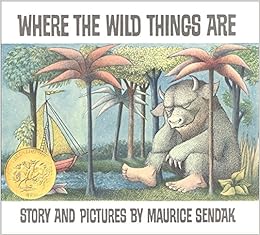
Sendak, M., & Sendak, M. (1963). Where the wild things are. New York: Harper & Row. 


Summary: Max is a young boy with a wild imagination who gets sent to his room without supper. While there he imagines his room is a forest "where the wild things are" and he fits right in for the time being. Young children with a wild imagination with love this book and be reminded of how nice it is to come back to reality every once and a while.

Visual Element: On Max’s journey in his private boat, Sendak’s use of lines in the picture show movement from the water. Lots of small lines to give the illusion of clouds, or maybe a gust of wind, and ripples on the flag on the top of the boat further display the movement on the page through lines.


Evaluation Criteria: I believe the evaluation criteria of setting is exemplified in this book. Max is sent to his room and his imagination slowly changes the setting to begin his adventure or escape. Even though the narrator states that Max is in this world for over a year, he returns to his original setting and finds his supper is still hot.


Singer, M., & Masse, J. (2010). Mirror mirror: A book of reverso poems. New York, NY: Dutton Children's Books.


Summary: This neat book is compiled of reverse poems and pictures that allow us to see different perspectives based upon the character. The poems and pictures come revisit well known fairy tales such as Red Riding Hood and Sleeping Beauty. 


Visual Element: Every drawing that is paired with a poem has a distinct symmetric line that reflects the reverse of the poems. For example, as Sleeping Beauty lies asleep on the left side of the page there is a clear line where her dress transforms into the lines of the hills that the prince rides through.


Evaluation Criteria: Singer uses a reverse style for poems where the same words are repeated, but the capitalization or punctuation in the poem may change, therefore, changing the meaning. This clever play with words is a style that shapes this entire book.


Smith, L. (2010). It's a book. New York: Roaring Brook Press. 

Summary: This is a humorous book that strives to point out the relevance, yet simplicity, of books versus technology. The donkey is shocked that the book doesn't need to charge or isn't password protected. Without all the bells and whistles, the donkey realizes the book is maybe just as cool as technology.

Visual Element: Line, shape, and color are all exemplified in this work. The simplicity of the lines from the chairs that the characters sit in, the colors are mellow, and the shapes are rigid and outlined. These visual elements contribute to the topic of the book. Books are simple. No charging cord, password, etc., unlike what the jackass is accustomed to.

Evaluation Criteria: The characters are introduced in the beginning of the book as a mouse, jackass, and monkey. One of the character’s ignorance concerning books shows that he really is what his name implies. A small mouse, usually seen as timid or shy creatures, makes this clear observation at the end of the book.


Wiesner, D. (2001). The three pigs. New York: Clarion Books. 


Summary: This book puts a spin on the typical story of The Three Pigs when the wolf actually blows the pigs out of the story line into a different setting where they meet different childhood story characters.

Visual Element: While reading this book, the texture stood out immensely. The page where the pigs start folding the pages to make a paper airplane looks very three dimensional. The texture that he continuously uses throughout to weave other stories in was a contemporary touch to this classic fable.

Evaluation Criteria: The illustrations in this book help create the mood when the wolf blows down the first little pig’s house and blows him right out of the book. As the illustrations cross over into other beloved fables a unique story is told.

Family Literacy Night

Click the following link to see an additional list of phenomenal books for kids sorted into the following categories:

1. Caldecott Award Winners
2. Children's Poetry
3. Easy Readers
4. Geisel Award Winners
5. Coretta Scott King Award Winners

List of books for Family Literacy Night

Caldecott Award Winning Books

Goble, P. (1978). The girl who loved wild horses. Scarsdale, NY: Bradbury Press.

In this book, Goble tells a story of a young Native American girl who shares such a  deep connection with horses that she's happy living with them after a storm drives her and the horses away from her home and family. Once her family finds her, she is sad that she has to leave the horses. Told with simple words and vivid paintings, kids will enjoy this story explaining the Native Americans' connections to the Horse People.


Chaucer, G., Cooney, B., & Lumiansky, R. M. (1958). Chanticleer and the fox. New York: Thomas Y. Crowell.

Barbara Cooney and Geoffrey Chaucer come together to present an adapted story from    the Canterbuy Tales of the fox and rooster. The fox has the best voice in the land, and even though he's given fair warning he still falls for the foxes flattery as he tells him he just came to hear him sing. Thankfully the rooster doesn't stay ignorant for long as he turns the tables back on the fox to escape back his family.


Scheer, J., & Bileck, M. (1964). Rain makes applesauce. New York: Holiday House.


This is a light-hearted book. It doesn't contain a plot, characters, or even a conflict. As stated in the book several times, "It's just silly talk." Julian Scheer talks about how rain makes applesauce, and gives examples of other crazy things that could happen if that were true. Marvin Bileck brings those things to life with his very detailed and graphic images. This book is the perfect fun read for kids.


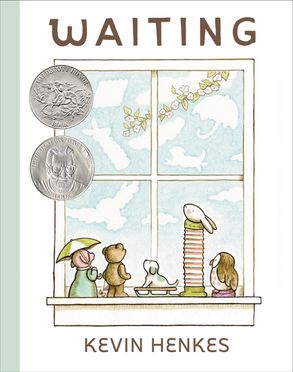
Henkes, K. (2015). Waiting (1st ed.). New York, NY: HarperCollins.

An owl, pig, bear, puppy, and rabbit experience different things such as weather, visitors, and individual things that make them happy as they wait for other marvelous    things to happen. When an unexpected visitor arrives, a cat, they are curious to find out what she's waiting for. Read this book filled with beautiful pictures of watercolor paint and color pencils to see if this unique family of friends ever find out.


McDermott, G. (1974). Arrow to the sun: A Pueblo Indian tale. New York: Viking Press.

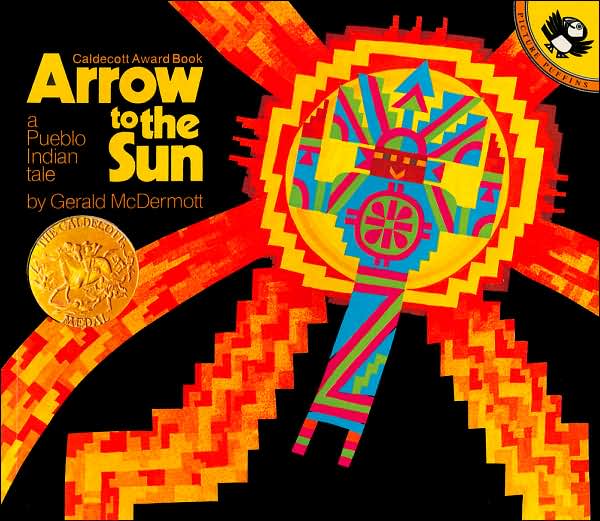
With contrasting geometric images full of dynamic, bold colors, McDermott tells a Pueblo Indian tale of a boy who is teased by the village kids for being fatherless. He sets out on a quest to find his father, but encounters some challenges along the way. He must first prove himself by passing through four chambers of ceremony. Read to find out if the boy is successful and challenge kids to think of another myth they might remember similar to this one.


Shannon, D. (1998). No, David! New York: Blue Sky.

Kids and parents will be able to relate to this book as we follow David through his day of mischievous activities as he does things that kids do like make too much noise, play with his food, track mud in the house , and refuse to settle down during bedtime.  David is familiar with the words "no," but his attitude changes once he is put in time out for breaking a flowerpot. David Shannon uses full page vibrant pictures to tell David's story.


Pinkney, J., & A. (2011). The lion & the mouse: A fable by Aesop. London: Walker Books.

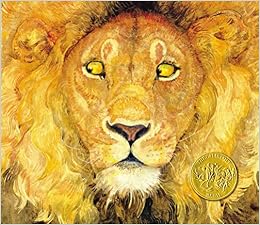
Pinkney retells one of Aesop's most popular fables with very few words, watercolor like   pictures that, and onomatopoeias. When the lion shows an act of kindness by releasing his prey, the mouse, it is up to the mouse to decide if she wants to return the favor when the lion is captured by a trap set up by poachers. Use this fable to exemplify a lesson that all kids need to learn.


Floca, B. (2013). Locomotive (1st ed.). New york, NY: Antheneum.


Follow this family as they take a trip from Nebraska to California on The Pacific Railroad in 1869. We look into a behind the scenes view of the workers, the way the train works, the dangers that were involved with taking the train, and the feeling of moving swiftly across the deserts and plains after the days of the slow moving Oregon Trail. Floca packs this book with lots of details and information to give readers a brief history lesson on exploring the country during that era.


Wiesner, D. (2006). Flotsam. New York: Clarion Books.

When a camera is washed ashore, a young boy wastes no time getting the pictures developed. He's amazed at the photographs that show him places that the camera has been, the people who have also found the camera, and just how long the camera has been out a sea being passed along. Through pictures that look like photographs, Wiesner passes along a story to readers. Kids will be eager to see whether the boy will choose to pass the camera/story along or keep the treasure for himself. 


Ackerman, K., & Gammell, S. (1988). Song and dance man. NY: Alfred A. Knopf.


In this book, a group of grandchildren spend the afternoon at their grandparents house. With an hour of time left to burn until grandma is finished with supper, the kids follow their grandpa into the attic to relive his days as a tap dancer. Vibrant color pencil-like drawings illustrate the fun filled night and highlight the irreplaceable bond between grandparents and grandchildren.