
Brown, P. (2014). My teacher is a monster!: No, I am not. Little Brown Books For Young Reader.
Summary: Every child has that one teacher that they dislike, and Robert is terrified of Ms. Kirby until he runs into her outside of school at the park. Slowly Robert starts to see Ms. Kirby in a different light and his opinion of her changes, for now.
Visual Element: Brown exemplifies color through his illustrations in the book. In particular, the color of Ms. Kirby changes throughout the book as Robert’s opinion of her changes. The author starts off using a deep green color, and then slowly transfers into a peach color.This doesn’t happen quickly, but instead it is a slow, gradual change over a course of pages.
Evaluation Criteria: The two settings in this book are crucial. The original setting serves as the place where Robert’s initial opinion about Ms. Kirby is formed, but when he sees her in a different setting, his view of her starts to change and so does her physical appearance in the book. Because of the settings, the plot is able to progress and brings the book back in a full circle where it originally started.
 DePaola, T. (1990). The Legend of the bluebonnet. Place of publication not identified: Scholastic.
Summary: This is a legend retold about a girl named She-Who-Is-Alone who has lost her family due to a famine. As her tribe looks for things to sacrifice to please The Great Spirits, many are not willing, but She-Who-Is-Alone sacrifices her most prized possession, her rag doll, and the next day a field of bluebonnets appear and the drought has ended.
Visual Element: The colors in this book reflected the different moods. During the famine the sky was plain white, or a very light brown. At times when they sang to the Great Spirits the sky would be a mixture of purple, blue, and pink, which made me think of hope. A light blue also crosses the sky when the rain begins to fall while blue bonnets color the hills that were once a light gray.
Evaluation Criteria: Through the characters’ names, clothes, speech, and rituals we see Native American culture. I believe the culture is presented in a way that would be interesting to children and inoffensive. There is also a good theme of sacrifice or selflessness taught that all students can relate to.
 Deedy, C. A., & Austin, M. (2007). Martina, the beautiful cockroach: A Cuban folktale. Atlanta, GA: Peachtree.
Summary: Martina is a beautiful cockroach ready to find a husband, but first they must pass the test. Her grandmother tells her that she must waste coffee on the suitors and see how they respond, but Martina meets her match when she meets a mouse that spills coffee on her first.
Visual Element: Austin exemplifies texture through the images in this book with his particular attention to detail.The intricate detail used for the expression on Martina’s face as she goes through different emotions of trying to find a husband is so realistic that it is easy to forget that she is a cockroach.
Evaluation Criteria: The plot is exemplified in this Cuban folktale, beginning with a conflict. The plot flows as Martina meets different characters to see if they can pass this test to be her potential husband. The resolution is clear and satisfying as the characters both discover they share a huge similarity, Cuban grandmothers.

Visual Element: The entire book is mostly shades of grey , white, and black. The main color that Falconer uses to convey Olivia’s personality is red. Olivia wears red while doing some of her favorite activities such as brushing her teeth, trying on different clothes, going to the beach, dancing, and painting. This also distinguishes her from her little brother. Red reflects her energetic spirit.
Evaluation Criteria: Olivia’s character is certainly the major focal point of the book. She is full of life, always on the go, and good at wearing people out. Olivia’s lively character moves the story along and makes you think of children you know that may be very similar to her in our everyday lives.

Klassen, J. (2012). This is not my hat. Somerville, MA: Candlewick Press.
Summary: A little fish takes a hat that doesn't belong to him and he's sure he will get to a place full of high plants where he can't be seen. However, the big fish finds him and gets his hat back.
Visual Element: In This Is Not My Hat, the author-illustrator uses very few shapes to aid in the storytelling. The big fish's oval body is so large that it takes up two pages versus the smaller fish, whose oval body hardly takes up a tenth of the page. Even the leaves of the plants reflect an oval shape, sometimes taking over the page as much as the giant fish.
Evaluation Criteria: Even though the story is told from the point of view of the small fish, Klassen clearly exemplifies that the other characters play a vital role in the story and eventually dominate the story without ever speaking a word. The main character, small fish, is oblivious to the actions of the other two characters, the crab and big fish, and this ultimately leads to his demise.
Summary: Every child has that one teacher that they dislike, and Robert is terrified of Ms. Kirby until he runs into her outside of school at the park. Slowly Robert starts to see Ms. Kirby in a different light and his opinion of her changes, for now.
Visual Element: Brown exemplifies color through his illustrations in the book. In particular, the color of Ms. Kirby changes throughout the book as Robert’s opinion of her changes. The author starts off using a deep green color, and then slowly transfers into a peach color.This doesn’t happen quickly, but instead it is a slow, gradual change over a course of pages.
Evaluation Criteria: The two settings in this book are crucial. The original setting serves as the place where Robert’s initial opinion about Ms. Kirby is formed, but when he sees her in a different setting, his view of her starts to change and so does her physical appearance in the book. Because of the settings, the plot is able to progress and brings the book back in a full circle where it originally started.
Visual Element: The colors in this book reflected the different moods. During the famine the sky was plain white, or a very light brown. At times when they sang to the Great Spirits the sky would be a mixture of purple, blue, and pink, which made me think of hope. A light blue also crosses the sky when the rain begins to fall while blue bonnets color the hills that were once a light gray.
Evaluation Criteria: Through the characters’ names, clothes, speech, and rituals we see Native American culture. I believe the culture is presented in a way that would be interesting to children and inoffensive. There is also a good theme of sacrifice or selflessness taught that all students can relate to.
Summary: Martina is a beautiful cockroach ready to find a husband, but first they must pass the test. Her grandmother tells her that she must waste coffee on the suitors and see how they respond, but Martina meets her match when she meets a mouse that spills coffee on her first.
Visual Element: Austin exemplifies texture through the images in this book with his particular attention to detail.The intricate detail used for the expression on Martina’s face as she goes through different emotions of trying to find a husband is so realistic that it is easy to forget that she is a cockroach.
Evaluation Criteria: The plot is exemplified in this Cuban folktale, beginning with a conflict. The plot flows as Martina meets different characters to see if they can pass this test to be her potential husband. The resolution is clear and satisfying as the characters both discover they share a huge similarity, Cuban grandmothers.
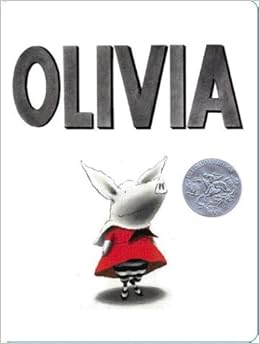
Falconer, I. (1975). Olivia. New York: Arno Press.
Summary: Get ready to follow Olivia around for a day through her various adventures and outfits. Busy body children will enjoy reading this book with their parents after a long, tiresome day.
Visual Element: The entire book is mostly shades of grey , white, and black. The main color that Falconer uses to convey Olivia’s personality is red. Olivia wears red while doing some of her favorite activities such as brushing her teeth, trying on different clothes, going to the beach, dancing, and painting. This also distinguishes her from her little brother. Red reflects her energetic spirit.
Evaluation Criteria: Olivia’s character is certainly the major focal point of the book. She is full of life, always on the go, and good at wearing people out. Olivia’s lively character moves the story along and makes you think of children you know that may be very similar to her in our everyday lives.

Klassen, J. (2012). This is not my hat. Somerville, MA: Candlewick Press.
Summary: A little fish takes a hat that doesn't belong to him and he's sure he will get to a place full of high plants where he can't be seen. However, the big fish finds him and gets his hat back.
Visual Element: In This Is Not My Hat, the author-illustrator uses very few shapes to aid in the storytelling. The big fish's oval body is so large that it takes up two pages versus the smaller fish, whose oval body hardly takes up a tenth of the page. Even the leaves of the plants reflect an oval shape, sometimes taking over the page as much as the giant fish.
Evaluation Criteria: Even though the story is told from the point of view of the small fish, Klassen clearly exemplifies that the other characters play a vital role in the story and eventually dominate the story without ever speaking a word. The main character, small fish, is oblivious to the actions of the other two characters, the crab and big fish, and this ultimately leads to his demise.
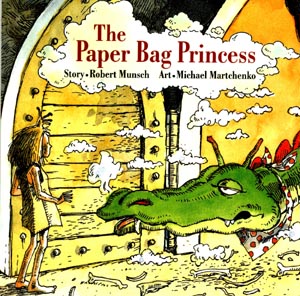
Munsch, R. N., & Martchenko, M. (1980). The paper bag princess. Toronto: Annick Press.
Summary: Elizabeth finds a clever way to outsmart the dragon that is keeping Ronald captive, but she doesn't get the thankful attitude from Ronald that she's hoping for because she's not dressed as a princess should be. Read along to see how Elizabeth reacts to Ronald.
Visual Element: Martchenko uses lines in the illustrations to assist in the storytelling and bring detail to the pictures rather than shading. On the first page where Elizabeth and Ronald are pictured, the brick/stone wall behind them is filled with hundreds of lines that are proof of the original pencil drawings.
Evaluation Criteria: The theme of this book is what sets it apart from the other typical princess stories. Elizabeth uses her brain to outsmart the dragon to save Ronald, and is instead rejected because of how she looks. She stays true to her clever self, insults Ronald, and continues on happy without him.
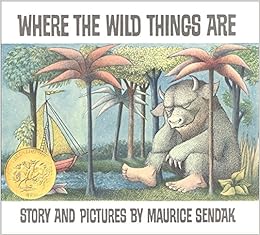
Sendak, M., & Sendak, M. (1963). Where the wild things are. New York: Harper & Row.
Summary: Max is a young boy with a wild imagination who gets sent to his room without supper. While there he imagines his room is a forest "where the wild things are" and he fits right in for the time being. Young children with a wild imagination with love this book and be reminded of how nice it is to come back to reality every once and a while.
Visual Element: On Max’s journey in his private boat, Sendak’s use of lines in the picture show movement from the water. Lots of small lines to give the illusion of clouds, or maybe a gust of wind, and ripples on the flag on the top of the boat further display the movement on the page through lines.
Evaluation Criteria: I believe the evaluation criteria of setting is exemplified in this book. Max is sent to his room and his imagination slowly changes the setting to begin his adventure or escape. Even though the narrator states that Max is in this world for over a year, he returns to his original setting and finds his supper is still hot.

Summary: This neat book is compiled of reverse poems and pictures that allow us to see different perspectives based upon the character. The poems and pictures come revisit well known fairy tales such as Red Riding Hood and Sleeping Beauty.
Visual Element: Every drawing that is paired with a poem has a distinct symmetric line that reflects the reverse of the poems. For example, as Sleeping Beauty lies asleep on the left side of the page there is a clear line where her dress transforms into the lines of the hills that the prince rides through.
Evaluation Criteria: Singer uses a reverse style for poems where the same words are repeated, but the capitalization or punctuation in the poem may change, therefore, changing the meaning. This clever play with words is a style that shapes this entire book.

Smith, L. (2010). It's a book. New York: Roaring Brook Press.
Summary: This is a humorous book that strives to point out the relevance, yet simplicity, of books versus technology. The donkey is shocked that the book doesn't need to charge or isn't password protected. Without all the bells and whistles, the donkey realizes the book is maybe just as cool as technology.
Visual Element: Line, shape, and color are all exemplified in this work. The simplicity of the lines from the chairs that the characters sit in, the colors are mellow, and the shapes are rigid and outlined. These visual elements contribute to the topic of the book. Books are simple. No charging cord, password, etc., unlike what the jackass is accustomed to.
Evaluation Criteria: The characters are introduced in the beginning of the book as a mouse, jackass, and monkey. One of the character’s ignorance concerning books shows that he really is what his name implies. A small mouse, usually seen as timid or shy creatures, makes this clear observation at the end of the book.

Wiesner, D. (2001). The three pigs. New York: Clarion Books.
Summary: This book puts a spin on the typical story of The Three Pigs when the wolf actually blows the pigs out of the story line into a different setting where they meet different childhood story characters.
Visual Element: While reading this book, the texture stood out immensely. The page where the pigs start folding the pages to make a paper airplane looks very three dimensional. The texture that he continuously uses throughout to weave other stories in was a contemporary touch to this classic fable.
Evaluation Criteria: The illustrations in this book help create the mood when the wolf blows down the first little pig’s house and blows him right out of the book. As the illustrations cross over into other beloved fables a unique story is told.

No comments:
Post a Comment
Please submit your comments here. All feedback is welcomed.